
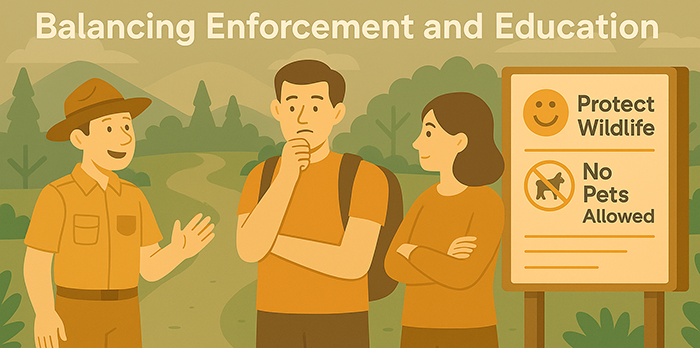
Balancing Enforcement and Education: Communicating Park Rules Without Alienating Visitors
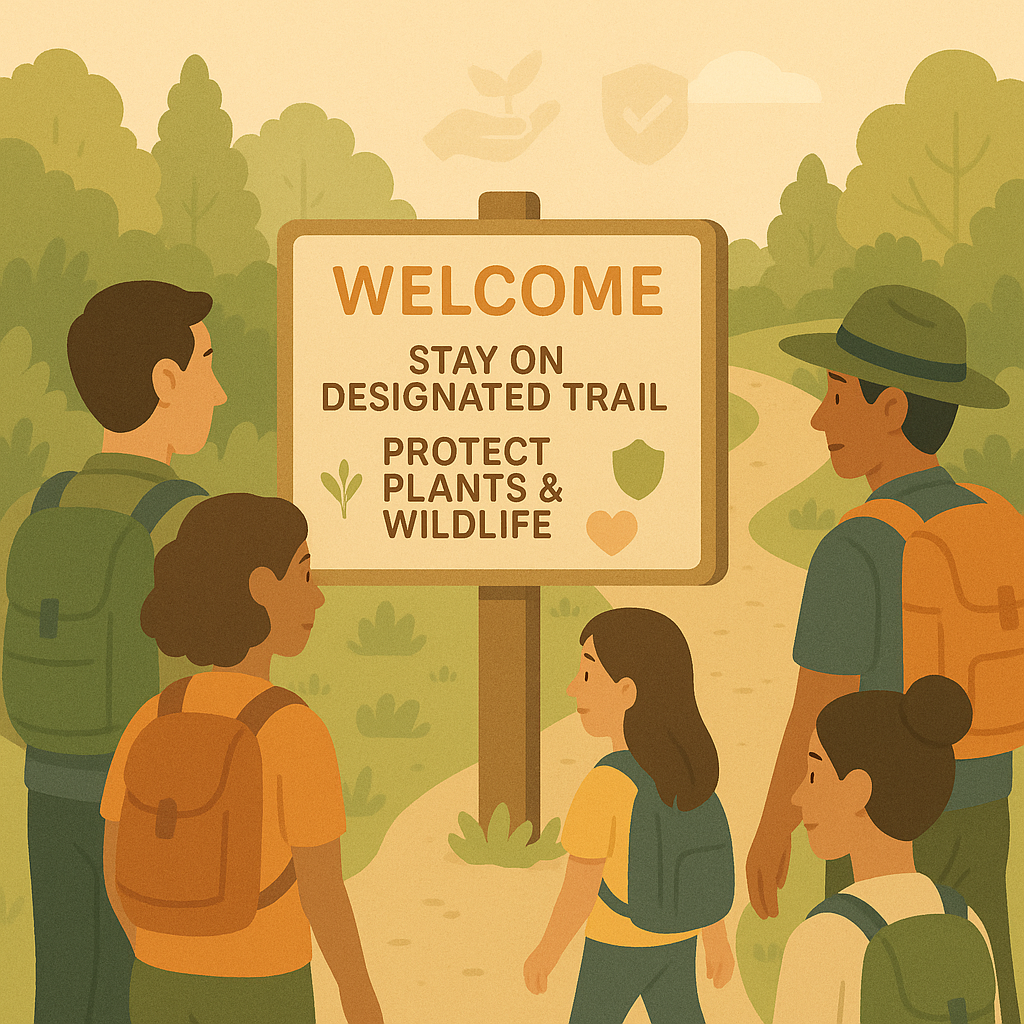 In many outdoor settings, from national parks to local trail networks, parks and recreation agencies, wildlife agencies, and outdoor recreation departments face an ongoing challenge in communicating rules that visitors will understand and willingly follow. Rules serve essential functions. They protect ecological resources, reduce risks, maintain order, and help agencies fulfill legal mandates. Yet rules that feel overly harsh can sour the experience for visitors. Rules that feel too gentle may be ignored. The challenge involves more than wording. It involves understanding the psychology behind how visitors interpret, absorb, and respond to information.
Parks and outdoor spaces are environments where people expect relaxation, autonomy, exploration, and enjoyment. When a rule interrupts that expectation, it must be delivered in a way that aligns with the visitor’s emotional and cognitive state. A rule written without empathy can erode trust. A rule written with care can reinforce it. The goal is not only to secure compliance but to preserve the visitor experience while encouraging stewardship. Park districts and other managing organizations that communicate rules effectively create spaces where visitors feel welcomed, respected, and guided toward safe and responsible behaviors.
Balancing enforcement and education is ultimately a communication exercise. It requires attention to tone, placement, clarity, context, and the subtle emotional cues embedded within both signage and staff messaging. Understanding how visitors interpret rules helps agencies design communication systems that protect the land, support safe recreation, and strengthen the visitor experience.
Understanding Visitor Psychology Around Rules
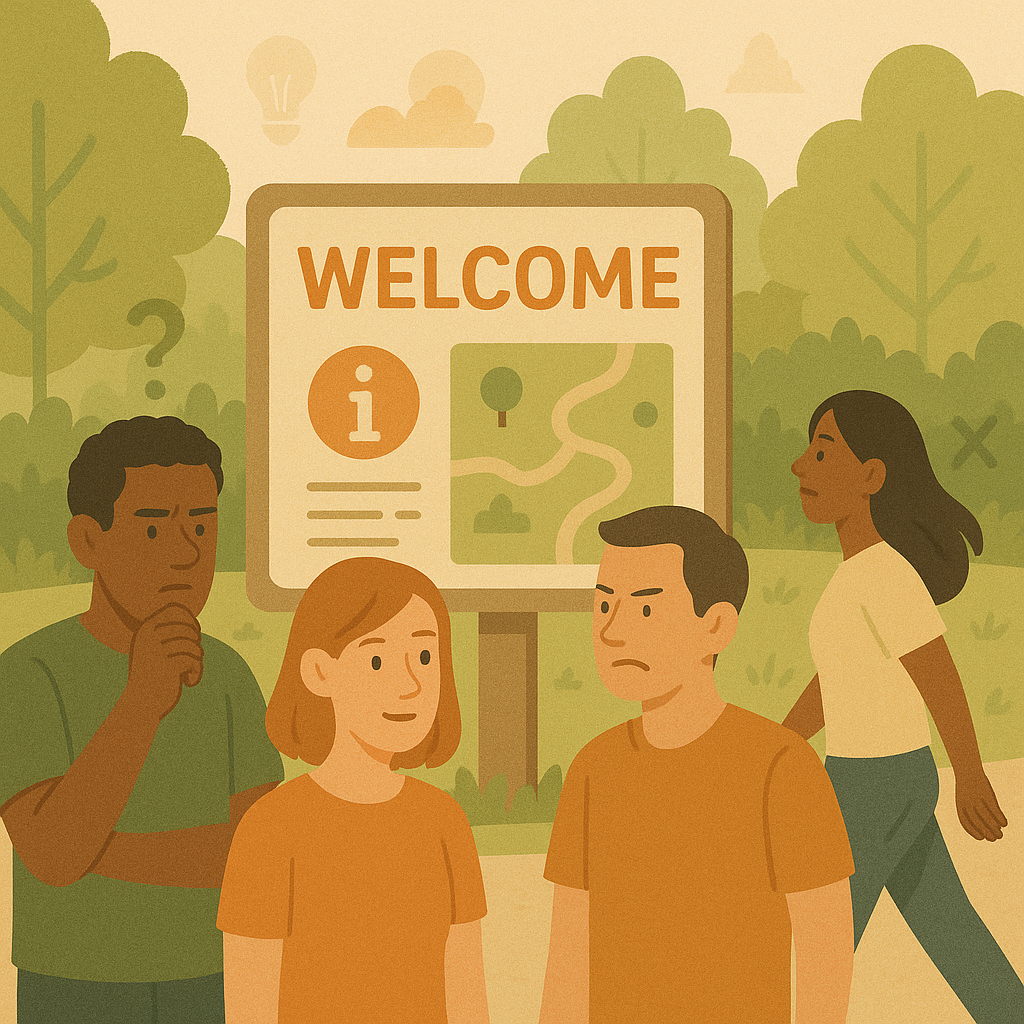 Visitors react to rules through the lens of prior experiences, cultural backgrounds, personal expectations, and their emotional state at the time of the visit. A person who arrives feeling excited will interpret a strict sign differently than someone who is already stressed or overwhelmed. Some visitors view rules as guidance that supports safety. Others associate rules with authority or limitation. These differences shape how people respond to posted information.
When a rule feels punitive or accusatory, visitors may interpret it as a personal judgment. Phrases like “Do not” or “Absolutely no” can trigger defensiveness, even when the visitor has not violated anything. Conversely, rules that emphasize shared responsibility or environmental care tend to reduce defensiveness because they affirm the visitor’s good intentions.
Visitors also use rapid mental shortcuts when interpreting signage. If a rule appears unnecessarily strict, they may question its legitimacy. If it is explained clearly, understanding increases and tension decreases. Wildlife agencies and outdoor recreation departments often see higher compliance when rules are framed around purpose rather than authority.
Social perception also plays a significant role. When visitors observe others ignoring a rule without consequence, they may assume the rule is optional. When communication is consistent, and when visitors see others modeling the expected behavior, compliance rises. Agencies that understand these social dynamics can design rule communication that leverages cooperation rather than triggering resistance.
Identity also shapes interpretation. Visitors who see themselves as experienced hikers or environmentally conscious individuals may believe that certain rules apply only to “other people.” This phenomenon, known as perceived exemption, leads some visitors to assume their personal judgment overrides posted guidance. Parks and recreation agencies and park districts can counter this by reinforcing collective responsibility. Messaging that highlights everyone’s role in safety and stewardship reduces the likelihood that visitors will exclude themselves from compliance.
Emotional priming further influences responses. Visitors already experiencing joy, curiosity, or relaxation interpret rules more positively than those feeling rushed, tired, or stressed. Rules placed in stressful locations such as crowded parking lots or trail bottlenecks must therefore be especially clear and supportive. Many wildlife agencies establish a cooperative tone early in the visitor journey by using welcoming signage at entrances, which sets a positive frame for subsequent rule communication.
Understanding these psychological layers allows agencies to design rule communication that aligns with natural human tendencies rather than working against them. This leads to clearer messaging, improved compliance, and a more enjoyable experience for all visitors.
From Trails to Tweets: Effective Communication Strategies for Parks, Recreation, Outdoors, and Wildlife Agencies
This article is part of our series on strategic communication for Parks, Recreation, Outdoors, and Wildlife agencies. To learn more and to see the parent article, which links to other content just like this, click the button below.
The Role of Education in Rule Communication
 Education offers visitors the context they need to comply with rules willingly. When people understand the reason behind a rule, they view compliance as responsible behavior rather than a limitation. Education transforms a rule from an obstacle into a shared goal.
For example, “Do not disturb wildlife” may be interpreted as rigid or unnecessary, especially by visitors who feel harmless. But a sign that explains, “Approaching wildlife causes stress and disrupts feeding patterns” provides the missing context. Visitors begin to understand that their actions, even if well-intended, have consequences.
Interpretive panels, trailhead messaging, brochures, ranger talks, and website resources all support educational rule communication. Visitors who understand ecological relationships or risk factors become more thoughtful participants in protecting natural spaces. Education deepens their awareness and appreciation for the landscape.
Many agencies find that when educational messaging precedes rule messaging, visitors are far more receptive. A visitor who learns about erosion, habitat sensitivity, or wildfire behavior becomes more willing to respect restrictions on trail access, fire use, or camping locations. Education builds internal motivation, making external enforcement less necessary.
Educational messaging also reaches visitors at different experience levels. New park users benefit from clear explanations, while experienced outdoor recreators appreciate communication that respects their knowledge yet still adds value.
When Enforcement Is Necessary
 Not all rules can rely solely on education. Some rules are required by law. Others protect life, sensitive habitats, or property. Enforcement messaging clarifies boundaries that cannot be crossed without consequence.
Effective enforcement messaging is:
- Clear
- Specific
- Direct
- Devoid of emotional language
Enforcement does not have to feel harsh. It simply needs to remove ambiguity. For example, “Area closed. Unstable ground beyond this point” communicates urgency without unnecessary severity. Visitors understand that the rule exists to protect them.
Enforcement is also necessary when risk is immediate and cannot be mitigated through personal judgment. Hazard zones, cliff edges, avalanche areas, flash-flood channels, active wildlife corridors, and fire danger levels often require definitive rule messaging. In these areas, softer tones could result in misinterpretation.
Agencies must also consider fairness when crafting enforcement language. Rules must apply consistently to all visitors, and they must be communicated in a way that shows the agency’s commitment to safety and stewardship rather than arbitrary control. When enforcement is consistent and well-explained, visitors perceive it as reasonable.
The challenge is ensuring that enforcement does not overshadow the visitor experience. A park filled entirely with prohibitions feels unwelcoming. That is why enforcement must be used strategically, complemented by educational and interpretive content. When visitors understand what is allowed as clearly as what is not, their experience feels more balanced.
Blending Enforcement and Education
The strongest rule communication systems rely on neither enforcement nor education alone, but on a thoughtful blend of both. Education builds understanding. Enforcement builds clarity. Together, they build trust.
A blended message acknowledges the visitor’s role in protecting the environment while also defining clear expectations. Consider this example:
“Help protect sensitive vegetation by staying on designated trails. Leaving the trail crushes young plants and causes erosion.”
This message gives the visitor a reason, a responsibility, and a boundary. It frames the visitor as a partner in conservation rather than a potential violator.
Agencies can also blend messages spatially. Educational messaging belongs in spaces where visitors make plans, such as trailheads or visitor centers. Enforcement messaging belongs near the point of action, such as at trail junctions or hazard zones. This layering ensures that visitors receive information in the moments they need it most.
Blended messaging also preserves visitor autonomy. When people feel respected and informed, they feel trusted. Trust increases voluntary compliance and reduces the need for staff intervention.
Blended communication also benefits from visual hierarchy. When educational and regulatory elements appear together, visitors need to instantly recognize which part explains context and which part defines the boundary. Agencies can achieve this with consistent text sizing, color choices that signal priority, spacing that separates ideas, and icons that reinforce meaning. Visitors often make decisions in just a few seconds. A clean visual hierarchy ensures the message is understood even if the text is only skimmed.
Agencies can also blend approaches by matching tone to the level of ecological sensitivity. Highly sensitive environments, such as nesting zones or restoration areas, justify firmer boundaries. Moderate-sensitivity areas may allow gentler messaging that leans more heavily on education. When visitors see that the tone aligns with the stakes, they perceive the agency as thoughtful and credible rather than overly restrictive.
Another strategy is pre-education. Before visitors encounter enforcement messages on the trail, agencies can provide educational explanations at visitor centers, parking areas, maps, and digital platforms. Pre-education reduces tension at enforcement points because visitors already understand the reasoning. By the time they see a directive sign, the message no longer feels abrupt or surprising.
This integration of timing, tone, placement, and visual structure transforms rule communication into a coherent experience rather than a series of isolated commands.
Cultural and Linguistic Sensitivity in Rule Messaging
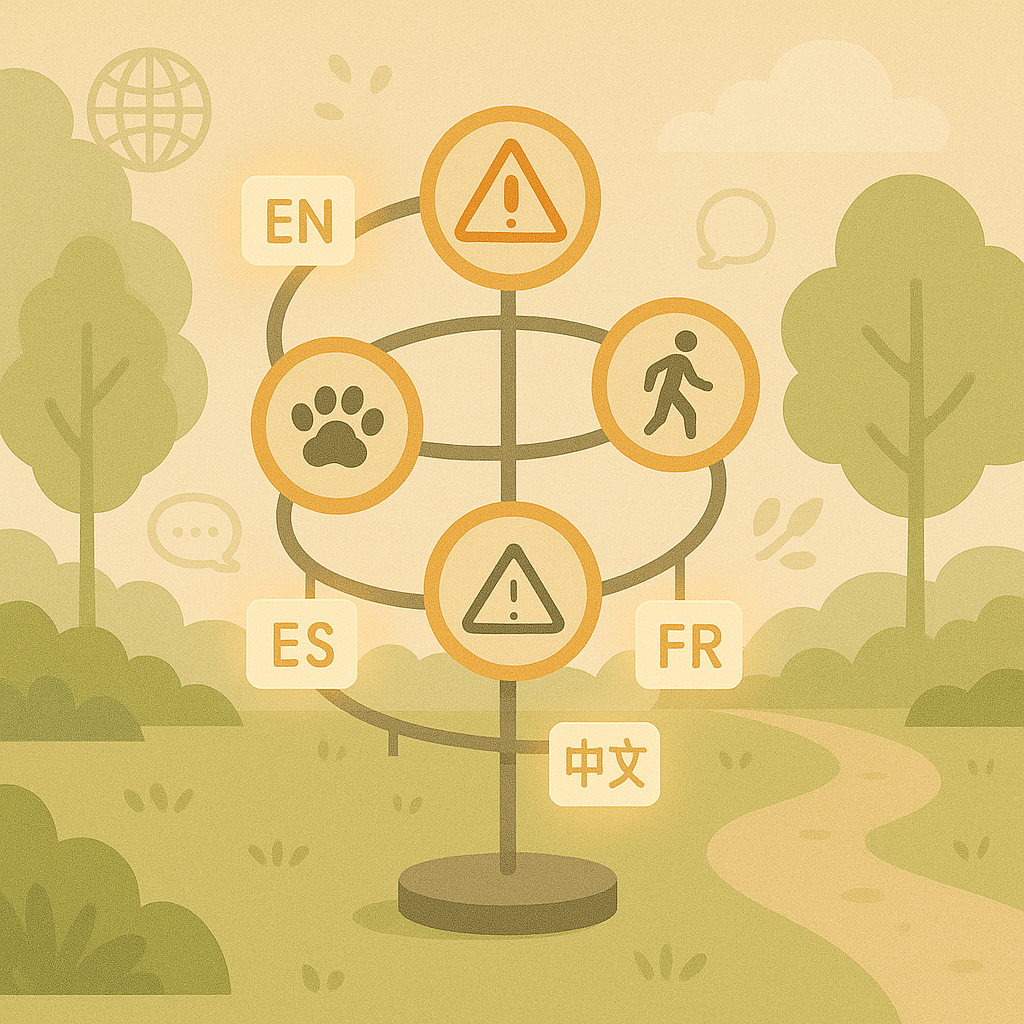 Rule communication must consider cultural and linguistic differences across visitor populations. Different cultures interpret rules, authority, and signage tone in different ways. Language that feels neutral to one cultural group may feel stern or ambiguous to another..
California State Parks encounters this dynamic regularly due to its high percentage of international visitors. Many of its rules involve safety warnings related to ocean hazards, wildlife, and terrain. To avoid alienating visitors, the agency uses multiple languages, universal icons, and simplified visual communication. This ensures that rule messages reach visitors regardless of reading level or familiarity with English.
Inclusivity also involves avoiding culturally loaded terms or assumptions. Rule communication should not imply blame. It should not stereotype or assume prior knowledge. Simple, direct, respectful language ensures that all visitors feel welcome.
Additionally, accessibility must be considered. Visitors with limited vision, reading challenges, or cognitive differences must be able to understand rule communication. High-contrast text, large fonts, thoughtful placement, and simple sentence structure are essential tools.
Cultural sensitivity strengthens the perception of fairness. When rules make sense to everyone, they are more widely respected.
Avoiding Alienation Through Tone and Placement
Many conflicts between visitors and agencies arise not because of the rules themselves but because of how they are communicated. Tone and placement play significant roles in shaping visitor reactions.
Tone determines whether visitors feel respected. A rule that reads, “Stay out. Violators will be prosecuted” feels confrontational. A rule that reads, “Area closed to protect fragile habitat. Thank you for helping us preserve this space” feels collaborative.
Placement determines when visitors receive information and how they interpret it. A sign that appears suddenly at the last possible moment may create frustration if the visitor has already mentally committed to a path. A sign placed too early may be forgotten. The most effective rule communication appears at natural decision points where visitors are already pausing or evaluating their next step.
Thoughtful placement reduces friction, and thoughtful tone prevents alienation.
Rule Compliance as a Shared Responsibility
The most successful parks and recreation agencies foster a culture where visitors feel that they are partners in caring for the land. This perspective shifts rule-following from obligation to contribution.
Shared responsibility messaging uses phrases such as:
- “Together we can protect this habitat.”
- “Your actions help keep wildlife safe.”
- “Thank you for helping preserve this trail.”
These statements acknowledge the visitor’s positive intent, motivate pro-environmental behavior, and frame rule compliance as part of a collective effort. The visitor becomes an ally rather than a potential problem.
This framing also promotes prosocial influence. Visitors who perceive themselves as contributors are more likely to model responsible behavior, influencing others in their group or nearby.
Helping Staff Reinforce Rules with Ease
Rangers, field staff, volunteers, and seasonal employees often provide the human face of rule communication. Signage alone cannot address every situation, and staff frequently serve as interpreters of rules when visitors have questions or encounter ambiguity.
Staff benefit greatly when rule communication is clear, consistent, and well-designed. When signage matches the tone, structure, and expectations that staff are trained to reinforce, visitor interactions become smoother and more positive. Staff can rely on the wording they see in the field, and visitors are more receptive when the message feels familiar.
Staff training in communication style, conflict reduction, interpretive techniques, and visitor psychology further strengthens the agency’s rule communication strategy. Empowered staff build trust and help visitors understand rules within a human-centered framework.
Building Rules Into the Visitor Journey
Rule communication is most effective when it is integrated naturally into the visitor experience rather than presented as a separate or competing element. Visitors move through outdoor spaces in predictable patterns. They arrive, orient themselves, navigate the landscape, engage in recreational activities, and eventually exit. Each of these phases offers opportunities for agency messaging to support understanding and shape behavior.
In the orientation phase, rule communication should be contextual and welcoming. Visitors benefit from being told not only what the rules are but what the experience offers and how they can enjoy it safely. Visitors are more accepting of rules when they perceive them as part of a larger set of tools designed to enhance their experience rather than restrict it.
As visitors enter deeper into the park, rules should be reinforced gradually. Instead of repeating identical messages, agencies can stagger information through educational reminders, visual cues, and interpretive elements. This creates a layered learning process. Visitors absorb information at the pace of their journey, which reduces cognitive overload and makes each rule feel relevant in the moment.
The exit phase also provides valuable opportunities for communication. Thank-you signage, stewardship prompts, and reminders about responsible behaviors create a complete narrative arc. Visitors leave feeling appreciated and aware of their contribution to maintaining the space. When rules are embedded into the entire visitor journey rather than presented as isolated commands, engagement and compliance significantly improve.
Why Some Rules Fail: Lessons from Behavioral Insights
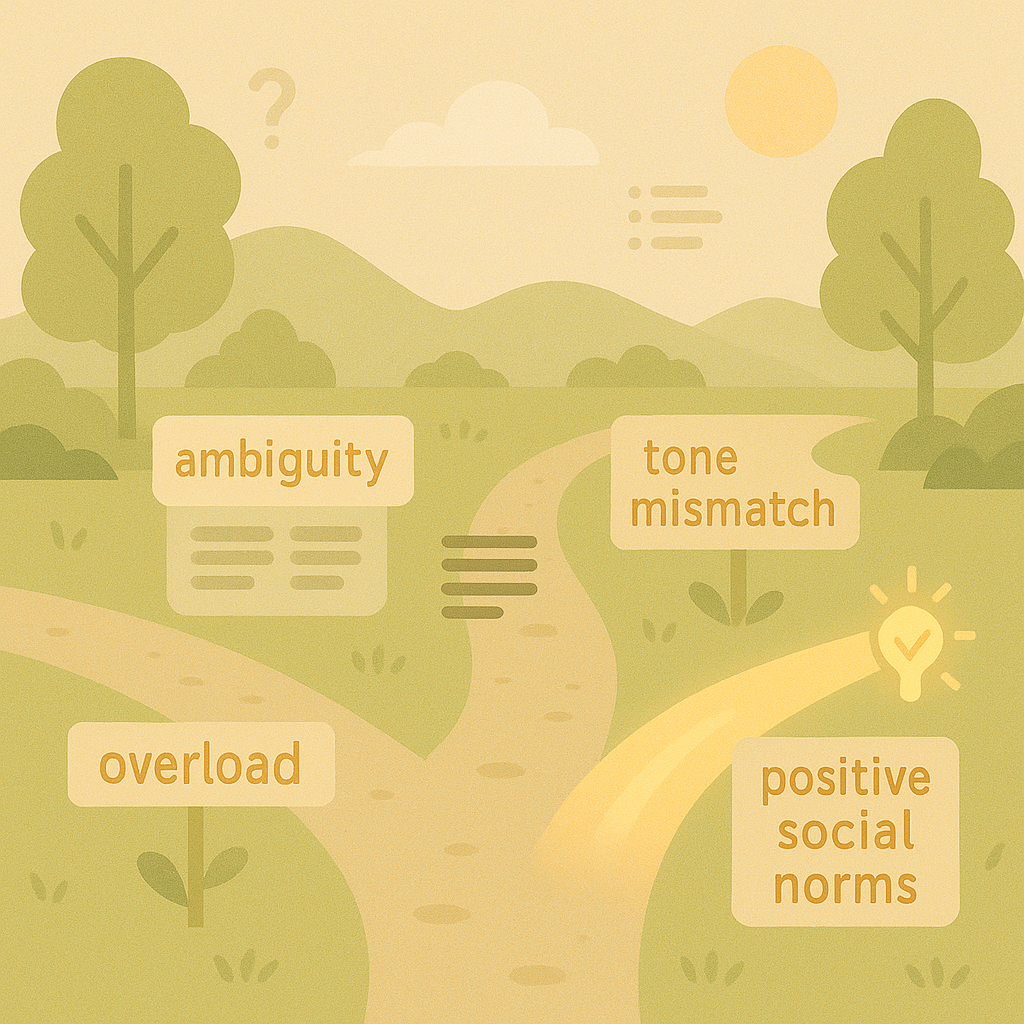 Understanding why certain rules fail helps agencies refine their approach. Behavioral research has identified several common pitfalls in public communication that apply directly to parks and recreational environments.
One common issue is ambiguity. Rules that use vague language such as “Use caution” or “Stay safe” fail to provide actionable guidance. Visitors must interpret meaning on their own, leading to inconsistent behavior. Clearer messages such as “Walk carefully. Steep, loose gravel ahead” improve compliance because expectations are specific.
Another pitfall is cognitive overload. When a sign contains too much information, especially in dense text, visitors may scan it quickly and misunderstand key points. Breaking content into short statements, using simple vocabulary, and pairing text with symbols helps reduce mental strain.
A third issue is tone mismatch. When a rule’s tone conflicts with the emotional context of the environment, visitors react negatively. For example, a harsh warning placed in a calm scenic overlook can feel jarring. Tone should match the degree of risk and the emotional expectations of the setting.
Finally, social influence plays a powerful role. If visitors observe others breaking a rule, they are more likely to perceive it as optional. Recreation and outdoors agencies must consider how signage and educational messaging can counteract this social normalization effect. One way is to highlight positive norms rather than negative behaviors. A message such as “Most visitors stay on the trail to protect fragile habitat” is more effective than “Do not leave the trail,” because it uses social proof to encourage compliance.
Understanding these behavioral dynamics allows agencies to redesign rule communication systems that reduce failure points and strengthen cooperation.
Using Interpretive Storytelling to Support Rule Compliance
Interpretive storytelling can be one of the most persuasive tools in rule communication. Rather than presenting rules as isolated expectations, storytelling frames them within narratives that highlight ecological, cultural, or historical connections.
For example, instead of stating, “Do not touch petroglyphs,” interpretive messaging might explain how ancient artists created them, how fragile the carvings are, and how modern visitors can help preserve them for future generations. This shifts the responsibility from forced compliance to meaningful stewardship.
Storytelling is memorable. Humans process stories more effectively than isolated facts. When interpretive messaging reveals the “why” behind a rule in a narrative form, visitors feel emotionally connected to the outcome. They become protectors rather than passive observers.
Agencies can use storytelling at trailheads, along heavily trafficked routes, and near sensitive natural or cultural features. Stories can highlight endangered species, local geology, watershed systems, indigenous histories, or conservation partnerships. When visitors understand the broader significance of a place, they become more thoughtful about their behaviors within it.
Interpretive storytelling also allows agencies to communicate complex or technical information in simple, engaging ways. It supports educational goals while reducing the likelihood of rule confrontation.
The Influence of Group Dynamics on Rule Interpretation
Visitors often experience parks in groups, whether families, friends, tour groups, or informal gatherings. Groups interpret rules differently than individuals. Social behaviors, peer pressure, and shared decision-making influence how rules are perceived and followed.
In groups, informal leaders often determine whether a rule will be respected. If the most confident or experienced person dismisses a sign, others may follow. Agencies can design rule communication to address group patterns by making messages visible from multiple angles, summarizing key points succinctly, and emphasizing collective responsibility.
Families present unique challenges. Parents must manage children’s curiosity, safety, and energy. Well-designed rule communication helps parents guide behavior without feeling overwhelmed. Simple icons, clear boundaries, and educational prompts tailored to younger audiences can reduce stress and improve safety.
Groups also tend to move quickly and may overlook signage if it is placed where individuals do not naturally pause. Positioning rule communication at natural gathering points, such as overlooks, junctions, rest areas, or educational stops, increases its effectiveness.
Understanding group behavior helps agencies tailor communication in ways that reach not only individuals but also the social units that shape collective decision-making.
Communicating Rules in High-Stress Situations
Risk perception changes dramatically when visitors are stressed, disoriented, or frightened. In high-stress moments, people experience reduced attention, slower information processing, and greater reliance on instinct. Rule communication must be designed to cut through stress and convey clear, actionable guidance.
In areas prone to flash flooding, rockfall, wildlife encounters, fast-moving weather changes, or other dynamic risks, messaging must be precise. Visitors under stress do not respond well to complex sentences or dense text. They need simple, direct instructions that can be understood at a glance.
For example:
“Turn back now. Flash flood risk ahead.”
This type of message eliminates uncertainty. Additional educational context should appear earlier in the visitor journey, not at the moment of risk. Agencies must balance preventive education with urgent enforcement communication so that visitors understand both the “why” and the “what now” at appropriate times.
Staff training is equally important. Rangers and volunteers must be prepared to communicate rules calmly and clearly during emergencies. Visitors often mirror the emotional state of staff, so confident communication supports safety and reduces panic.
By designing both physical signage and staff communication protocols for high-stress situations, agencies ensure that visitors receive the guidance they need exactly when they need it.
Agencies must also consider how visitors behave after the stressful moment has passed. Post-event rule communication helps visitors process what happened, learn from it, and avoid repeating risky behaviors. For example, after a temporary trail closure due to wildlife activity or weather hazards, agencies can post brief explanations that reinforce the lesson without placing blame. This encourages long-term awareness rather than fear or embarrassment.
High-stress communication should also be tested under real conditions. Agencies sometimes evaluate signage only in ideal weather or daylight, failing to consider how messages will appear in fog, dusk, snow, glare, or heavy crowds. Conducting field tests during a variety of environmental conditions helps identify visibility gaps. Reflective materials, bold icons, simplified phrasing, and contrast ratios become especially important when conditions impair decision-making.
Furthermore, agencies can use scenario planning to strengthen communication systems. By mapping how visitors move during emergencies, where they cluster, where they panic, where their attention narrows, agencies can redesign sign placement and staff positioning to support more orderly responses. Scenario planning turns high-stress communication from reactive to proactive, making the entire system more resilient.
Designing Rule Communication for Digital and Social Media Platforms
Modern park users often check websites, social media pages, reservation systems, or apps before visiting. This shift creates opportunities for agencies to communicate rules and expectations long before visitors arrive on the landscape.
Digital rule communication helps reduce confusion at entry points and prepares visitors for the type of experience they can expect. For example:
- Trail closures
- Fire restrictions
- Parking limitations
- Seasonal wildlife activity
- Weather advisories
- Equipment requirements
Providing rule messaging digitally prevents surprises and reduces frustration.
Social media also allows agencies to educate visitors through short stories, behind-the-scenes insights, caretaker perspectives, and real-time updates. These humanizing elements make rule communication feel less authoritative and more collaborative.
Digital platforms also support multilingual communication, accessibility tools, alt-text for images, and audio descriptions for those who prefer spoken information. This broadens the reach of rule communication and ensures that diverse visitors feel included and prepared.
When digital communication aligns with on-site rule messaging, visitors experience a cohesive system that reduces cognitive load and builds trust.
Internal Organizational Alignment Around Rule Messaging
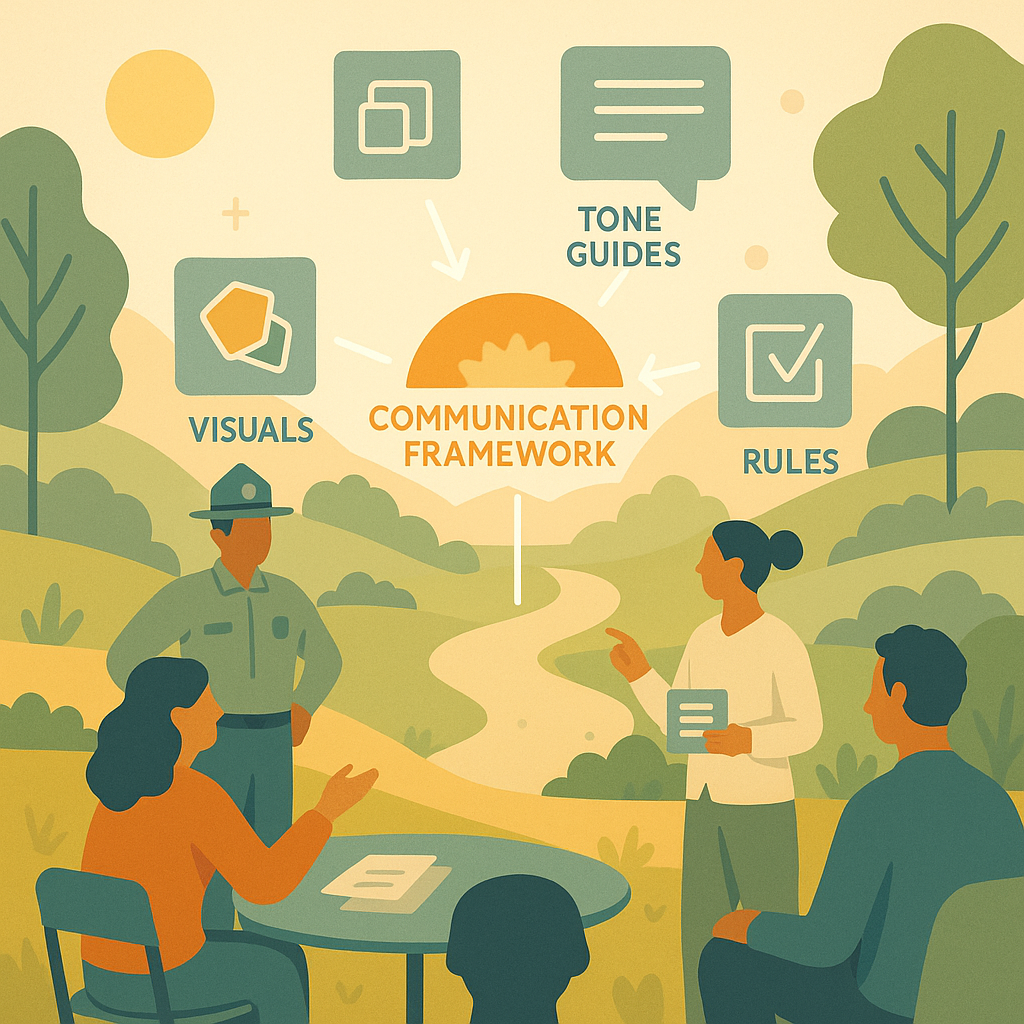 Many rule communication problems originate internally rather than externally. When different departments within an agency interpret rules, policies, or priorities differently, visitors receive inconsistent messages. This inconsistency reduces trust and increases conflict.
For example, if one department uses formal regulatory wording and another uses educational language, visitors may perceive the agency as disorganized or contradictory. Aligning tone, terminology, and visual design across internal teams strengthens the credibility of rule communication.
Internal alignment also reduces staff uncertainty. When staff members understand not only the rules but the reasoning behind them, they feel more confident and supported in communicating with visitors. This reduces tension between staff and visitors and enhances the overall visitor experience.
Agencies benefit from establishing internal guidelines that define communication tone, sign structure, placement standards, and messaging priorities. This internal clarity ultimately translates into clearer messaging in the field.
Internal alignment also requires consistent decision-making frameworks. If different units within the agency apply rules differently, staff may deliver mixed messages to visitors, eroding trust. For example, one ranger might permit a borderline behavior while another strictly prohibits it. Visitors then perceive the agency as inconsistent or unfair. A clear internal communication plan outlines not only what the rules are but how they should be explained, enforced, and contextualized across all staff roles.
Cross-department workshops can further strengthen alignment. When field staff, communications teams, planners, and administrators discuss rule messaging together, they develop shared understanding and anticipate challenges before they appear in the field. These workshops also allow staff to surface practical concerns about enforcement that may not be visible to leadership.
Additionally, internal alignment reduces staff stress. When staff know exactly how to explain rules to visitors, when to offer flexibility, and when to escalate enforcement, they feel more confident. Confidence translates into calmer interactions, which in turn improves visitor cooperation. Internal alignment is not simply an operational goal; it is a visitor-experience goal as well.
A Communication Framework That Supports Stewardship
Rule communication should not be viewed as a standalone task but as part of a larger communication ecosystem within the agency. This includes interpretive programs, visitor outreach, internal communication processes, staff training, digital communication, and signage strategy.
When communication strategies reinforce each other, visitors receive a coherent experience. Rules feel connected to mission. Signage feels aligned with staff behavior. Digital messaging matches on-site interpretation.
This cohesive approach strengthens stewardship. Visitors who feel they understand the agency’s goals and values become more invested in protecting the landscape. When rule communication supports a positive experience rather than detracting from it, visitors develop long-term connections to the place.
Promoting Long-Term Stewardship Through Communication
Long-term stewardship emerges when visitors feel emotionally connected to a place and understand how their actions affect its integrity. Rule communication contributes to this relationship by framing rules as tools for care, not barriers to enjoyment. When visitors consistently receive messages that acknowledge their role in preserving the landscape, they begin to see themselves as stewards rather than consumers of a recreational service.
Stewardship-oriented communication also extends beyond the visit itself. Post-visit touchpoints, email follow-ups for pass holders, social media content, volunteer invitations, and educational campaigns, reinforce the idea that responsible behavior is an ongoing partnership between the agency and the community. Visitors who identify as protectors of the space are more likely to comply with rules, model positive behavior, and advocate for funding or conservation efforts.
Agencies can also highlight success stories that show how visitor behavior makes a difference. When visitors see that staying on trail reduces erosion or that proper food storage decreases wildlife conflict, they internalize the importance of rules. This narrative shifts rule compliance from obligation to pride.
Stewardship-focused communication creates a cycle of trust, connection, and responsibility that benefits both visitors and the environment long into the future.
Strategic Communication Support for Your Parks and Recreation Agency
 Effective rule communication depends on a well-aligned organizational communication system, where messages are clear, consistent, and supported across internal teams. When messages are unclear or inconsistent, visitors may feel frustrated, staff may feel unsupported, and the agency’s mission may appear fragmented. Because of these challenges, agencies often choose to partner with an external resource like Stegmeier Consulting Group (SCG) to help bring structure and clarity to their communication strategies.
SCG supports agencies in strengthening their organizational communication framework. This includes aligning internal teams around shared messaging goals, clarifying expectations across departments, and ensuring staff feel confident communicating with the public. By helping teams reduce ambiguity and improve workflow consistency, SCG enables agencies to communicate rules in ways that reinforce trust rather than tension.
Effective communication begins internally. When staff share a unified understanding of tone, priorities, and messaging, visitors benefit from more consistent experiences. SCG helps agencies build communication systems that minimize confusion, support staff at all levels, and reflect the agency’s commitment to public service.
For parks and recreation organizations seeking to balance education, enforcement, and positive visitor engagement, a thoughtful communication strategy creates a stronger foundation for long-term success.
Conclusion
Communicating rules in parks and recreation settings is a nuanced task that requires empathy, clarity, psychology, and an understanding of the visitor experience. The goal is not only to protect the landscape and ensure safety but to foster positive relationships between visitors and public spaces.
By blending education with enforcement, considering cultural and linguistic differences, designing communication for group and individual behavior, and ensuring internal alignment, agencies create communication systems that feel supportive rather than restrictive. Rules become tools for stewardship rather than barriers to enjoyment.
When visitors feel respected, informed, and connected to the landscape, rule compliance becomes natural. Parks and public lands benefit, ecosystems thrive, and visitors leave with experiences rooted in trust and appreciation.
SCG’s Strategic Approach to Communication Systems
Align your agency’s messaging, processes, and public engagement strategies
Agencies that communicate effectively build stronger trust with staff, stakeholders, and the public. Whether you are improving rule communication, refining internal workflows, or strengthening agency-wide alignment, SCG can help you develop a communication system that supports consistent decision-making and long-term organizational success. Use the form below to connect with our team and explore how a strategic communication framework can elevate your agency’s impact.