
Desert Resilience, Connected Infrastructure: How Maricopa County, Arizona Pioneered Extreme Heat Infrastructure Communication
 In Maricopa County, Arizona home to Phoenix and over 4.7 million residents), extreme heat poses unprecedented challenges to public health, infrastructure operations, and community safety. In 2023, the county experienced a record-breaking 645 heat-related deaths, making it a critical case study in how local governments are adapting communication strategies to address climate-related public health emergencies. This case study examines the real programs and initiatives implemented by Maricopa County and its partner agencies to address extreme heat through coordinated communication, infrastructure adaptation, and community engagement.
The Challenge: Extreme Heat as a Public Health Crisis
Maricopa County faces some of the most extreme heat conditions in the United States. In 2024, Phoenix experienced 142 days with temperatures at or above 100°F, with summer temperatures regularly exceeding 115°F. The county has set new records for heat-related deaths every year since 2016, with vulnerable populations including people experiencing homelessness, older adults, outdoor workers, and those with substance use disorders facing the greatest risks.
The extreme heat affects every aspect of county operations, from infrastructure maintenance to emergency response. Construction work becomes dangerous during daylight hours, asphalt becomes too hot to touch, electronic systems fail from thermal stress, and transportation infrastructure experiences increased failures precisely when residents depend on it most to access cooling centers, medical care, and essential services.
Key Agencies and Programs
Maricopa County Department of Transportation (MCDOT)
MCDOT plans, designs, constructs, and maintains roadways primarily within the unincorporated areas of the county. The department currently operates and maintains approximately 2,500 miles of roadway, over 80 bridges, over 325 culverts, more than 160 signalized intersections, and approximately 35,000 traffic signs across 9,224 square miles.
Maricopa County Department of Public Health (MCDPH)
MCDPH leads the county’s heat response efforts and has made significant investments in climate and health infrastructure. In response to record heat deaths, the department hired a Climate and Health Program Manager and a Heat Relief Coordinator to focus specifically on supporting the county’s heat relief site infrastructure. MCDPH has conducted robust surveillance to track heat-related deaths since 2006.
Heat Relief Network
The Heat Relief Network was initiated in 2005 by the Maricopa Association of Governments (MAG) and is comprised of public, private, and non-profit volunteer organizations working together to reduce heat-related deaths in Maricopa County. The network coordinates four types of facilities:
- Cooling centers: Air-conditioned spaces where volunteers and workers offer water
- Respite centers: Indoor, air-conditioned spaces with water, places to rest, restrooms, charging stations, food, and medical checkups
- Hydration stations: Indoor or outdoor stations that provide cool water
- Collection and donation sites: Support locations that help other centers continue providing care
Communication and Response Strategies
1. Intergovernmental Coordination and Extended Hours
In 2024, MCDPH established Intergovernmental Agreements (IGAs) with Phoenix, Glendale, Chandler, Mesa, and Tempe to expand heat relief services. These partnerships ensure that at least one heat relief site in each city remains open until 7:00 PM Monday through Friday and is open at least one weekend day. This coordination addresses a critical gap in heat relief availability during late afternoon and evening hours when many facilities would otherwise close but temperatures remain dangerously high.
Phoenix took the most aggressive approach by opening a 24-hour heat respite site during summer 2024 and extending hours at other heat relief sites, which saw more than 28,000 visits. Phoenix was the only Valley city to offer overnight heat relief. Through these heat relief sites, Phoenix secured shelter or permanent housing for more than 800 people experiencing homelessness, including 120 families with young children.
In 2023, the Heat Relief IGAs provided 17,254 hours of heat relief center services for 41,024 individual visitors who received 178,031 bottles of water. The centers also distributed 121,820 snacks and heat relief kits containing hats, sunscreen, and hygiene items.
Why It Worked
The intergovernmental coordination approach succeeded because it created a unified safety net across municipal boundaries that residents could access regardless of where they lived or which city’s services they typically used. When Phoenix residents could access cooling centers in Tempe or Glendale without bureaucratic barriers, the entire network became more effective than any single city’s efforts.
The extended hours proved critical because heat-related deaths don’t follow business hours. Analysis of fatalities showed many occurred during evening and overnight periods when temperatures remained above 90°F but traditional cooling centers had closed. By keeping facilities open until 7:00 PM and offering 24-hour options, the county addressed the dangerous gap between when people assumed it was “safe” to leave cooling centers and when temperatures actually dropped to safer levels.
The coordination also enabled resource sharing and consistency in messaging. When all participating cities used the same communication protocols and service standards, residents received consistent information regardless of which agency they contacted. The shared funding model through IGAs made it financially feasible for smaller cities to maintain extended hours they couldn’t afford independently.
2. Multilingual Communication and Community Access
MCDPH partnered with Arizona 2-1-1 to staff call centers with community health workers and promotoras who speak English and Spanish. These specialists help residents find cooling and respite centers, water stations, and other heat relief support including utility assistance and air conditioning repair and replacement from 9:00 AM to 7:00 PM daily.
Maricopa County has invested significantly in multilingual services across departments. The county established a Spanish Translation Workgroup focused on cultural and linguistic competency in the Spanish language. The workgroup researched and collaborated to determine the most understood use of words and terminology by the local Spanish-speaking community, removing regional colloquialisms to ensure translated materials are accessible to all Spanish speakers.
The county provides interpreting services for individuals with limited English proficiency across multiple departments and encourages identification of language needs at the earliest point of contact. This multilingual approach recognizes that effective heat safety communication requires understanding cultural backgrounds and heat experience levels, not just language translation.
Why It Worked
The multilingual approach worked because it went far beyond simple translation to address cultural competency and community trust. Community health workers and promotoras brought existing relationships and cultural understanding that made them more effective than generic translated materials. When Spanish-speaking residents received guidance from someone who understood their cultural context and could explain heat safety in culturally relevant terms, compliance and help-seeking behavior improved significantly.
The partnership with Arizona 2-1-1 created a centralized, accessible resource that residents already knew and trusted for information. Rather than creating a new heat-specific hotline that required public education, leveraging an established system meant people could access help through a familiar phone number. The extended 9:00 AM to 7:00 PM hours ensured that working families could call after work hours.
The Spanish Translation Workgroup’s attention to removing regional colloquialisms proved especially important in a county with Spanish speakers from diverse origins including Mexico, Central America, and South America. Using universally understood Spanish rather than region-specific dialects ensured that all Spanish speakers could understand critical safety information regardless of their country of origin. This linguistic precision likely prevented confusion during heat emergencies when clear communication can be life-saving.
 3. Construction Industry Heat Safety Adaptations
Arizona’s construction industry has implemented significant schedule modifications to protect workers from extreme heat. The Arizona Department of Transportation (ADOT) and its private construction partners readjust work schedules to avoid the hottest parts of the day, with much construction work taking place overnight.
In May 2025, Arizona Governor Katie Hobbs signed Senate Bill 1182, which standardizes construction hours statewide to protect workers from extreme heat. The law allows construction work to begin as early as 5:00 AM on weekdays and 7:00 AM on Saturdays from May 1 through October 15. Concrete pouring can begin as early as 4:00 AM. The law overrides more restrictive local ordinances and provides consistency across Arizona’s varied jurisdictions.
Construction companies train workers to recognize heat-related illnesses and hold pre-shift meetings to review conditions crews will encounter and when to take breaks. All new employees undergo internal climate programs to prepare them for the work ahead.
In March 2024, Phoenix passed a heat safety ordinance requiring all employers with outdoor workers under city contracts, leases, and licenses to have a heat safety plan on record. Plans must include availability of free cool drinking water, access to shade or air-conditioned rest areas, training on recognizing and responding to heat illness, and emergency response procedures.
Why It Worked
The construction industry adaptations worked because they addressed the fundamental incompatibility between traditional construction schedules and extreme desert heat. By shifting work to early morning and overnight hours, workers could complete the same tasks with significantly reduced heat exposure. The 5:00 AM start times allowed crews to work productively during the coolest part of the day, typically between 5:00 AM and 11:00 AM, before temperatures became dangerous.
The statewide legislation (SB 1182) succeeded because it created consistency across jurisdictions, eliminating confusion for construction companies working on projects in multiple cities. Previously, contractors had to navigate different noise ordinances and start time restrictions in each municipality, making it difficult to implement uniform heat safety practices. The standardized approach also prevented a patchwork of conflicting regulations that could inadvertently force workers into dangerous heat exposure in some areas.
Phoenix’s requirement for documented heat safety plans worked because it moved heat protection from voluntary best practices to mandatory compliance. When contractors knew their plans would be reviewed and that non-compliance could affect future contracts, heat safety became a planning priority rather than an afterthought. The specific requirements for water, shade, training, and emergency response created clear standards that companies could implement and the city could verify.
The pre-shift meetings and worker training proved effective because they addressed the reality that heat tolerance varies by individual and changes day-to-day based on factors like hydration, sleep, and acclimatization. When supervisors reviewed daily conditions and workers understood how to recognize heat illness symptoms in themselves and coworkers, the entire crew became a safety team rather than relying solely on top-down enforcement.
4. MCDOT SMARTDrive Program: Connected Vehicle Technology
The Maricopa County Department of Transportation is recognized nationally as a leader in Connected Vehicle Technology through the MCDOT SMARTDrive Program. Since 2008, MCDOT and its partners (the Arizona Department of Transportation, the University of Arizona, and the Institute of Automated Mobility) have been actively testing Connected Vehicle technology in Anthem, Arizona.
The program began as a research project to address emergency vehicles crashing at intersections when multiple units were responding to calls simultaneously. The 5.3-mile test bed in Anthem features 11 signalized intersections equipped with infrastructure that allows traffic signals and approaching vehicles to exchange information using dedicated short-range communications (DSRC).
Key capabilities of the SMARTDrive Program include:
Emergency Vehicle Priority: The system prevents emergency vehicle collisions by using connected vehicle technology to exchange messages with multiple emergency vehicles responding to an incident and prioritizing their routes through intersections. The system assigns priority categories to each vehicle (emergency vehicle, transit vehicle, freight vehicle, personal vehicle) and communicates this information to reduce collision possibilities.
Multi-Modal Intelligent Traffic Signal System (MMITSS): Developed by the University of Arizona research team, MMITSS is a vehicle prioritization application that enhances traffic signal operations through advanced detection, smarter priority, and adaptive algorithms. The system provides coordinated traffic signal priority to transit vehicles, emergency vehicles, freight vehicles, and pedestrians.
Freight and Transit Efficiency: The program has developed signal priority applications to decrease delay and improve schedule reliability for freight and transit vehicles. This reduces wear and tear on roadways from constant starting and stopping while also reducing emissions as vehicles idle less.
Vulnerable Road User Alerts: The system uses alerts to notify drivers about pedestrians, cyclists, and other non-motorized roadway users in the vicinity.
In 2024, MCDOT entered a new phase of the SMARTDrive Program. The U.S. Department of Transportation provided over 600 After Market Safety Devices (ASDs) to deploy in commercial and government fleet vehicles, and possibly private vehicles, significantly expanding the program’s reach beyond the Anthem test bed.
The SMARTDrive Program is being leveraged for larger regional projects, including the Loop 101 Mobility Project, a partnership between ADOT and MCDOT aimed at developing technology to decrease congestion and improve safety in the Phoenix metro area through Integrated Corridor Management and connected vehicle initiatives.
Why It Worked
The SMARTDrive Program succeeded because it addressed a specific, documented safety problem (emergency vehicle collisions at intersections) with a technology solution that provided immediate, measurable benefits. By starting with a clear use case rather than implementing technology for its own sake, the program demonstrated value that justified continued investment and expansion.
The long-term commitment to the Anthem test bed (since 2008) allowed for thorough testing, refinement, and validation before broader deployment. This patient approach built confidence in the technology’s reliability, which is essential for systems that emergency responders depend on during life-threatening situations. The 16-year track record provided proof of concept that enabled the U.S. Department of Transportation to invest in scaling the program with 600 additional devices.
The multi-modal approach worked because it created benefits for multiple stakeholders rather than optimizing for only one type of user. Emergency vehicles gained safer, faster response times. Transit agencies improved schedule reliability. Freight companies reduced fuel costs and vehicle wear. Pedestrians and cyclists received safety alerts. When the technology served diverse users, it built broader political support and demonstrated wider value to the community.
The partnership model between county government, state transportation department, and university researchers combined practical operational knowledge with academic research rigor. MCDOT understood real-world transportation challenges, ADOT provided statewide perspective and resources, and University of Arizona researchers developed sophisticated algorithms and conducted rigorous evaluation. This combination ensured the program remained both theoretically sound and practically implementable.
The program’s relevance to extreme heat conditions, while not its original purpose, became apparent as the technology proved reliable even when temperatures exceeded 115°F. In conditions where other electronic systems fail from thermal stress, the DSRC-based infrastructure continued functioning, making it particularly valuable for desert environments where infrastructure reliability during extreme heat is critical for public safety.
5. Public Communication and Awareness Campaigns

The City of Phoenix established an Office of Heat Response and Mitigation (OHRM, also known as HeatReadyPHX) to lead efforts of what it calls “the hottest large city in the United States” to fight the growing hazard of urban heat. The office focuses on both heat response (helping people cope with hot weather) and heat mitigation (cooling the city and making it more comfortable).
Phoenix developed a comprehensive 2025 Heat Response Plan that includes:
Public Communication Strategy: The city shares heat safety and cooling resource information through print and digital communication channels, including social media. Multiple websites provide heat safety information and links to related resources, including phoenix.gov/summer. These resources are updated annually to more effectively engage with heat-vulnerable populations and the community at large.
Community Partnerships: Phoenix partnered with the Red Cross to coordinate a volunteer-led outreach program for residents of mobile and manufactured homes, focusing on educating residents about available resources and promoting heat safety. The city also partnered with the Nature Conservancy to help implement the Urban Heat Leadership Academy, a local heat education and capacity-building program.
Business and Employer Engagement: Phoenix formed a business advisory committee in early summer 2024 to develop a recommended model heat safety plan to provide to businesses, recognizing that workplace heat safety requires coordinated community-wide action.
Extended Library Services: Phoenix Library locations served as Cooling Centers throughout the 2024 heat season and continue this commitment. The city extends hours at three cooling centers to 10:00 PM each day of the week and adds capacity from noon to 10:00 PM on Sundays throughout the heat season.
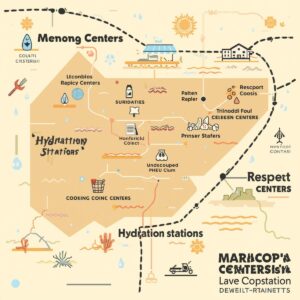
The Heat Relief Network provides an interactive map showing all cooling centers, respite centers, hydration stations, and water bottle donation collection sites throughout the county, making it easy for residents to find nearby resources.
Why It Worked
The Office of Heat Response and Mitigation succeeded because it elevated heat from a seasonal emergency response issue to a permanent organizational priority with dedicated leadership and resources. By creating a specific office focused solely on heat, Phoenix signaled that extreme heat is not a temporary challenge but a permanent condition requiring sustained attention and innovation. This institutional commitment enabled long-term planning and coordination that wouldn’t be possible with temporary seasonal staff.
The dual focus on response and mitigation addressed both immediate safety needs and long-term urban design. While response efforts saved lives during the current heat season, mitigation efforts like urban greening and heat-reflective surfaces would reduce future heat exposure. This balanced approach prevented the city from being perpetually reactive while also not neglecting immediate life-safety needs.
The multi-channel communication strategy worked because different populations access information through different media. Younger residents might see social media posts, older adults might rely on library resources, outdoor workers might receive information through employer partnerships, and Spanish-speaking residents might access information through community organizations. By maintaining consistent messaging across multiple platforms, the city ensured that heat safety information reached diverse audiences through their preferred channels.
The partnership with the Red Cross for mobile home outreach proved especially effective because manufactured housing communities face unique heat vulnerabilities (less insulation, smaller living spaces, aging cooling systems) and often house older adults on fixed incomes who may delay seeking help. Volunteer-led outreach created trusted relationships that made residents more willing to accept assistance and access cooling resources before reaching crisis situations.
The library-based cooling centers succeeded because libraries are familiar, non-stigmatized community spaces that people already know and trust. Unlike emergency shelters or specialized heat relief sites that some residents might avoid due to concerns about regulations or social stigma, libraries welcomed everyone without judgment. The extended evening and weekend hours recognized that people need cooling resources when they’re not at work, not just during traditional library hours. By converting existing trusted infrastructure into cooling centers rather than creating separate heat-specific facilities, the city reduced barriers to access.
Measurable Outcomes and Success Indicators
First Decline in Heat Deaths Since 2014
The 2024 heat season marked a significant milestone: despite being the hottest summer on record in Maricopa County, heat-related deaths declined for the first time in over a decade. The county recorded 602 confirmed heat-related deaths in 2024 (with 8 deaths still under investigation), down from 645 deaths in 2023.
This 6.7% reduction occurred despite more extreme temperatures, suggesting that coordinated communication, expanded heat relief services, and community education efforts are beginning to show measurable impact. From June 18 to July 31, 2024, at least one heat-related death occurred every day in Maricopa County during a 44-day period when 14 excessive heat warnings were issued and 14 high temperature records were broken.
While county leaders emphasize that any heat death is preventable and unacceptable, the decline provides evidence that intensive, coordinated heat response efforts can save lives even as climate conditions worsen.
Transportation and Construction Safety Improvements
The construction industry reports fewer heat-related incidents among workers due to modified schedules and enhanced training. Early morning start times allow crews to complete more work during cooler hours, reducing exposure to peak afternoon temperatures. Workers and supervisors report improved awareness of heat illness symptoms and better access to cooling resources and hydration.
The MCDOT SMARTDrive Program has demonstrated measurable improvements in emergency response times and intersection safety. According to U.S. Department of Transportation projections, connected vehicle technology has the potential to reduce crashes by 80% when drivers are not impaired. The program’s success in Anthem has led to expanded deployment and served as a model for other jurisdictions nationwide.
Lessons Learned and Best Practices
1. Coordination Across Multiple Jurisdictions Is Essential
Maricopa County’s success depends on coordination between county government, multiple cities, non-profit organizations, private sector partners, and state agencies. No single entity can address extreme heat alone. The Intergovernmental Agreements model provides a framework for shared funding, coordinated service delivery, and consistent messaging across jurisdictional boundaries.
Regular communication between partner agencies allows for sharing of effective strategies, troubleshooting of implementation challenges, and continuous improvement of programs. Monthly meetings between county staff and city partners review expenditures, discuss ongoing concerns, identify areas for improvement, and share successful approaches that could benefit other communities.
2. Extended Hours Address Critical Gaps in Service
Traditional heat relief services that operate only during standard business hours leave vulnerable populations without resources during evening and overnight hours when temperatures can remain dangerously high. Phoenix’s 24-hour respite site and extended evening hours at other locations address this critical gap.
Analysis of heat-related deaths shows that many occur during evening and overnight hours. Providing continuous access to cooling resources throughout the entire heat season, not just during peak daytime hours, is essential for protecting the most vulnerable community members.
3. Multilingual and Culturally Competent Communication Saves Lives
Effective heat safety communication requires more than simple translation. Understanding cultural differences in heat perception, risk awareness, and help-seeking behavior is critical. Newcomers from cooler climates need different education than long-term desert residents. Outreach must be tailored to specific populations including outdoor workers, people experiencing homelessness, older adults, and families with young children.
Community health workers and promotoras who speak residents’ languages and understand their cultural contexts are more effective than generic translated materials. The partnership with Arizona 2-1-1 provides accessible information and navigation support in both English and Spanish during extended hours.
4. Infrastructure Technology Can Enhance Emergency Response and Safety
The MCDOT SMARTDrive Program demonstrates how technology can improve infrastructure operations in extreme conditions. Connected vehicle technology enables emergency vehicles to respond more quickly and safely, reduces traffic congestion, improves public transit reliability, and provides real-time information to drivers about road conditions and hazards.
As extreme heat becomes more frequent and severe, technology solutions that enhance infrastructure resilience and emergency response capability become increasingly valuable. The success of the Anthem test bed has led to broader regional deployment and demonstrates the potential for scalable solutions.
5. Measurement and Data Drive Continuous Improvement
Maricopa County’s robust surveillance system for tracking heat-related deaths provides essential data for evaluating program effectiveness and identifying areas for improvement. Without consistent measurement, it would be impossible to know whether interventions are working or where to focus resources.
The county’s willingness to transparently report both successes and challenges enables evidence-based decision-making. The first decline in heat deaths since 2014 provides motivation to continue and expand effective programs while also highlighting that much work remains to be done.
6. Climate Adaptation Requires Long-Term Investment
One-time emergency responses are insufficient for addressing the ongoing challenge of extreme heat. Maricopa County has invested in permanent staff positions (Climate and Health Program Manager, Heat Relief Coordinator) and sustainable programs rather than relying solely on temporary seasonal responses.
Construction industry adaptations, including statewide legislation standardizing early start times, represent systemic changes rather than ad hoc solutions. The Heat Relief Network’s nearly 20-year history demonstrates the value of sustained commitment to addressing heat as an ongoing public health priority.
 Challenges and Areas for Continued Work
Despite significant progress, substantial challenges remain:
Scale of the Problem: With 602 heat-related deaths in 2024 even after intensive interventions, it is clear that current efforts, while helpful, are not yet sufficient to prevent all heat deaths. As climate change continues, temperatures are expected to become even more extreme, requiring continuous expansion and improvement of programs.
Resource Limitations: Funding for heat relief services remains a challenge. The 2023 Heat Relief IGAs cost $1,755,088 in operating expenses alone, not including staff time for grant management and oversight. Scaling services to meet growing need requires sustained funding commitments from multiple sources.
Reaching the Most Vulnerable: People experiencing homelessness account for a disproportionate number of heat deaths. While outreach programs have made progress, reaching individuals who may be difficult to locate, reluctant to seek services, or unable to access traditional cooling centers remains an ongoing challenge.
Substance Use and Heat: In 2024, 349 heat-related deaths involved substances, with 89% involving stimulants. The intersection of substance use disorders and extreme heat requires specialized approaches that address both issues simultaneously.
Infrastructure Limitations: Not all areas of the county have equal access to cooling centers, public transportation to reach cooling resources, or infrastructure designed for extreme heat. Addressing geographic disparities and infrastructure vulnerabilities requires long-term investment in capital improvements.
Conclusion
Maricopa County’s approach to extreme heat demonstrates that coordinated, multi-faceted strategies combining infrastructure adaptation, technology innovation, community partnership, multilingual communication, and sustained investment can reduce heat-related deaths even as temperatures continue to rise. The county’s first decline in heat deaths since 2014 provides evidence that comprehensive heat response programs can save lives.
Key elements of success include:
- Coordination across multiple agencies and jurisdictions
- Extended hours and 24-hour services to address gaps in traditional service delivery
- Multilingual and culturally competent communication
- Technology innovation through programs like MCDOT SMARTDrive
- Legislative action to protect outdoor workers
- Data-driven evaluation and continuous improvement
- Long-term investment in staff, infrastructure, and programs
As extreme heat becomes more frequent and severe due to climate change, Maricopa County’s experience offers valuable lessons for other jurisdictions facing similar challenges. The county’s programs demonstrate that while extreme heat is a growing threat, coordinated community action can protect vulnerable populations and save lives.
However, the county’s experience also highlights that no single program or intervention is sufficient. Effective heat response requires sustained commitment, adequate resources, continuous innovation, and willingness to learn from both successes and failures. With 602 heat-related deaths in 2024, county leaders recognize that much work remains and that protecting all residents from extreme heat will require ongoing community-wide effort.
Ready to Elevate Your Agency’s Public Communication?
We understand the unique challenges state and local government agencies face—from complex issues to diverse community needs. Our comprehensive approach can help you transform the way you connect with constituents, improve transparency, and highlight the valuable work your agency does every day.
Interested in learning more? Reach out to us today for a consultation. We’d love to discuss how our services can support your goals and help you build lasting trust with the communities you serve.